Wednesday, July 24, 2013

3 Common Misconceptions About Following Jesus

So many of the things we believe, are things we don't even think about. We pick them up in our earliest years from our parents, teachers, friends, and the culture at large. Some of them are things deliberately taught, values passed down from the previous generation, like the idea that all people should be treated equally. Others are so ingrained into our culture that we never question them, like the superiority of sliced bread to unsliced.

We have picked up a lot of subtle beliefs about Jesus as well, and what he asks of us. Some of them are wrong, contrary to the Gospel. Often, these misconceptions go untested.

1. Following Jesus is a Religious Thing

“So what do you think of Jesus?”
“I go to church and all that”

Jesus never asked anyone to go to church. His call was simply “follow me.”

The words “religion” and “religious” are only found ten times in the NIV Bible. Most of those clearly refer to the Jewish religion (Amos 5:21, Acts 25:19, Colossians 2:16, and Hebrews 10:11) and many of those show “religion” in a negative light, sometimes directly opposed to God.

Jesus was a member of the Jewish faith. He remained so all his life, faithfully keeping the Law, showing that it was meant to point to himself. But most of the things Jesus talked about had little to do with his religion, other than a general faith in God. Jesus spent a lot of time telling people about the kingdom of God. He talked about loving others, neighbors, enemies, anyone. He talked about how we spend our money, how we treat our children, how we make peace with others. He talked about prayer and fasting, but he specifically criticized those who made a religious show of them. He taught us that prayer and fasting are primarily something between ourselves and God.

Jesus never talked about church buildings, programs, services, pews, or ceremonies. He never told people to be priests, or ministers. He never commanded people tithe to their church. Jesus never discussed forms of worship, and whether we should be contemporary, traditional, or liturgical.

Jesus did not come to earth to start a new religion called Christianity. He came to bring people to God. Following Jesus is not about religion. It is not about promoting religion, or trying to get people to join our particular brand of Christianity. Following Jesus is living life in away that brings people closer to God, wherever they may be on that journey.

2. Following Jesus is a Personal Thing

“I can just worship God in my truck or on the lake.”

One of the distinctives of American culture is our “rugged individualism,” our determination to make it on our own, not influenced, not dependent on others. Our cultural axioms include: “Be your own man,” “Follow your dream,” and “Do it your way.” We have a tendency to read this into the Bible as well.

Jesus never intended us to go at it alone. Faith is a deeply personal thing, but it is also a deeply communal thing. I can not love my neighbor without a neighbor. I can not encourage others if I don't talk to them. I can not confess my sins to others and pray for them (James 5:16) all by myself.

Much of the New Testament is composed of letters written to specific churches. By churches, I do not mean 501(c)3 organizations that meet in a building with pews and stained glass. Rather, the New Testament word “church” simply means “group.” It was written to groups of people together. People who were often diverse, but shared a common connection as disciples of Jesus.

Anytime in my life that I have been growing as a disciple. Anytime I have deepened my understanding of God and the world. Anytime I have become more like Jesus, It was in the context of a group of people encouraging me, teaching me, caring for me. And it almost always happened as I was doing the same thing back to them.

3. Following Jesus is an Easy Thing

“I asked Jesus into my heart once. Did you see my new truck?”

I am not here to judge an individual's temporal or eternal relationship with God. I can say this with certainty, following Jesus is not about praying a prayer, believing a doctrine, or even getting baptized (although those are all often involved in a decision to follow Jesus). Following Jesus is about living life like Jesus. It is saying, “Jesus knows more than me, I am going to trust him and do things his way.” This is not an easy thing to do.

Jesus said it like this,
“Or suppose a king is about to go to war against another king. Won’t he first sit down and consider whether he is able with ten thousand men to oppose the one coming against him with twenty thousand? If he is not able, he will send a delegation while the other is still a long way off and will ask for terms of peace. In the same way, those of you who do not give up everything you have cannot be my disciples.” (Luke 14:31-33)

So if you want to follow Jesus, to be his disciple, it will cost you everything. Don't do it unless you are ready for trouble.

Here is what I have experienced. Sometimes following Jesus means bucking the trends of society. Society does not always get it right. Sometimes following Jesus means bucking the trends in the church. The church doesn't always get it right either. You will get persecution from all sides. You will be too liberal for your conservative friends, too conservative for your liberal friends. If your highest aim is for people to like you, following Jesus might not be for you.

So why follow Jesus? I do it for the rewards. I am not altruistic. I am not a good enough person to just love everyone for their own sake. But I trust that when I do love people, when I do it like Jesus , it will be worth it.

“Truly I tell you,” Jesus said to them, “no one who has left home or wife or brothers or sisters or parents or children for the sake of the kingdom of God will fail to receive many times as much in this age, and in the age to come eternal life.”

For every thing I have given up, for every criticism I have endured, I have received a multitude of blessings. I have always been provided for physically. I have witnessed God transform lives. I have seen enemies embrace. I have seen neighborhoods rebuilt. I have an ever increasing family in this life. I have a lot to look forward to in the next.

Friday, July 12, 2013

These Are Our Children


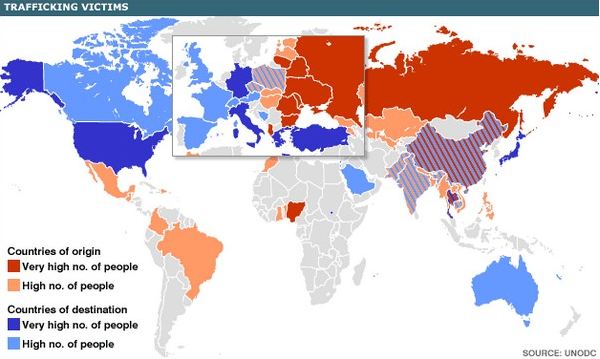
The facts are staggering. Every year more than a million kids are trafficked for sexual exploitation and forced labor around the world.  Across the world, children are  subjected to rape multiple times every night. They are subject to beatings, abuse, and sexually transmitted diseases. They are afraid. They feel helpless. They feel unloved.

Victims of sexual trafficking often remain in the sex industry even after they become physically free to do so. It is the only work they know. It is the only value they have been shown. The slavery never really ends.

I knew trafficking was a problem. But it isn't something I really like to think about. When I decided to open my eyes to the problem, I found I didn't even know the half of it. Here's some things that shocked me.

 - It's not just girls. Although young girls may be the picture we often have in our minds for sexual trafficking, an estimated 400,000 boys and young men are victims of sex trafficking each year.
 - It doesn't just happen in some third-world country out there. An estimated 100,000 children in the U.S. are involved in the sex industry. The U.S. is the second largest destination for human trafficking in all its forms.
- It's big business. Human trafficking is the second largest criminal industry (after the drug trade) and brings and estimated $32 billion each year.

So I know what you might be thinking. I've never trafficked anyone. I've never participated in child prostitution or child pornography. Maybe I should think about donating money to an organization that fights trafficking, but really, this isn't my problem.

Business needs a supply and a demand to grow. The supply for child sex trafficking comes from poor vulnerable people in some of the poorest neighborhoods and the least developed countries of the world. But the demand - that comes from us. The demand for sex trafficking does not begin with a pimp on a seedy street corner. It does not begin with a creepy guy in a trench coat. The demand begins when people are looked on as something less than a bearer of the image of God. It happens when we objectify a person.

We objectify a person when we look at them for what they can give us. This can happen in a lot of ways, and not all of them are sexual. Most of us wold agree that  in viewing pornography, we objectify a person. But we can do the same thing by the way we look at someone who passes us on the street. There was a reason Jesus warned against looking at a woman with lust (Matt 5:28). It wasn't just some prudish, archaic rule to keep us in line.

Lust and pornography are not victim-less crimes. When we devalue one human being to an object, we devalue every human being. So what starts as an "innocent" second glance progresses to an obsession with fulfilling our desires at someone else's expense. It will hurt our relationships. Eventually, without any checks, it can lead to such an objectification that we would harm another person, even an innocent child to fulfill our desires. We like to think we are insulated from such evil, but it is not as far as we might think.

The bottom line is that we are all responsible for child sex trafficking. We are responsible by what we do. We are responsible by what we don't do. We are responsible by what we choose to ignore.

Photo: Roses are red,
Violets are blue,
We are safe,
Because of you!!!

This is the sweet face of one of the little girls in a Rapha House prevention program.  Every day, teams of RH social workers are dispersed into high risk trafficking communities. We reach out to children and families in these communities with education about trafficking as well as physical services.  We have a responsibility, not only to minister to child victims in our safe house programs, but also to stop trafficking from taking place before children are victimized.  

This Valentines Day, we want to say thank you for showing love to the children of Rapha House.  None of this is possible without you!

Photo by Theara- RH Kid's Club DirectorThese are our children. They are not nameless faces on a street. They are boys and girls created in the image of God. Each has a name. Each has a story.

These are our children. This isn't a problem some other people have in some other part of the world. We can't pretend we don't know it is happening, both in America and around the world.

These are our children. We live in the wealthiest nation on earth. We have power and resources to stamp out human trafficking. We are not helpless to come to their aide. We are just unwilling to get our hands dirty.

These are our children. Our sons and daughters are just a step away from slavery, when we allow them to be viewed as objects. When we objectify another human being, we are adding fuel to the growing inferno that is human trafficking.

These are our children. Every girl you look at online is someone's daughter. The ad revenue alone from visits to such sites fuels the pornography industry, creating a demand, making it more likely that another life will be destroyed by trafficking.

These are our children. Because it is not right to deny justice to the innocent (Provebs 18:5). Because God defends the cause of the fatherless (Duet 10:18). Because Jesus was compassionate to the helpless (Matt 9:36). Because our highest act of worship is to look after widows and orphans in their distress (James 1:27)

If God has so moved you, please consider joining the cause of rescuing children from sex trafficking. For more information, visit raphahouse.org and blackboxinternational.org


Stats courtesy of: http://abolitionmedia.org/about-us/modern-slavery-statistics and blackboxinternational.org

Friday, June 28, 2013

Loving Our Undocumented Neighbors

Migrant Farm Workers Are the Backbone of the Agricultural IndustryIt's all over Scripture. I like the frankness off Leviticus 19:33-34 “Do not take advantage of foreigners who live among you in your land... love them as you love yourself.” (NLT) But you can find similarly worded commands in Exodus 22, Psalm 94, Zecheriah 7 and all throughout the Hebrew Scriptures. Jesus also thought pretty highly of foreigners in his day, saving his highest compliments for them (Luke 7:9, 17:18)

God has a special place in his heart for foreigners. I do too. I do not mean to imply that I am more godly than others because of my regard for foreigners. I have sympathy for their plight, because I was one once.

I am not an immigrant to America. I was born in Iowa. I did, however live in the Middle East for more than two years where I was a foreigner. I moved to a country where I did not speak the language. I had no friends. I did not have a job lined up when I got there, or a residence visa, (although I did enter the country legally with a visit visa). I placed a lot of hope and not a small number of prayers in finding a job that would grant residency to me and my family. I studied hard to learn the language, I was told that I excelled in my study. But in the end, my Arabic was still broken, at times incomprehensible to native speakers. My friends were very patient with me to figure out what I was saying, and to word things simply enough that I could understand them.

Sometimes I think people are under the impression that immigrants coming to America have it made. They have arrived, after all. They made it to the greatest country on earth. They have freedom and opportunity at their fingertips. They can just sit back and relax and enjoy the blessings of prosperity. We get even more cynical about those who enter or stay in the country illegally, that is without the proper residence permits. We act like they maliciously came in to this country to steal someone's job and claim government benefits they are not entitled to.

I don't think most Americans realize what it means to be a foreigner. We don't realize how much we depend on the relationships of family and friends, how cut off we really are when they are not around. We don't realize all the rules, both laws and social mores we take for granted, that a foreigner simply would not know. It's difficult to do simple things like pay bills or get a drivers license when they are done so differently than in your home country. Most of us have never really tried to master a second language, or know how difficult it is to live in a place where you don't speak the language. Immigrants are often victims of trafficking and exploitation. They often simply don't understand all that is going on around them. Or they are just too desperate to care. I don't think most immigrants would put up with half the crap they take if the situation were not so dire, if people back home were not depending on the money they send for their next meal.

Immigration has returned to the national dialog as a contemporary shibboleth. Your stance on immigration will show who you are: bold progressive, limp-wristed moderate, or true-blooded American. I hesitate to say anything, because I hate to put too much weight on politics. We won't solve the issues of immigration with politics or a new piece of legislation. But there are some clear spiritual issues that need to be addressed. You can not follow Jesus and hate the foreigners living among us. You can not love the foreigners living among us and refuse to acknowledge their existence. You can not love the foreigners among us without feeling compassion for their dire situation or taking action to bring justice to them.

Denying justice to the foreigner. That was one of God's indictments against sinful Israel in Ezekiel 22:29. That is exactly what is going on today in America. Undocumented Immigrants have no legal status. When they fall victim to a crime (which happens quite a lot) they avoid reporting it for fear of being deported, or imprisoned. They broke an immigration law. You've probably broken some laws too: driving over the speed limit, and possibly some far worse things. Does that broken law make it justifiable for someone else to steal your wages or force our daughter into prostitution? As long as we force immigrants to live off the grid, they will never receive justice, let alone the compassion we owe them.

First, we have to face the fact that immigrants are not going anywhere. Expelling them all is logistically impossible. It would also be devastating to our economy, driving up prices on a number of goods and services that are supported by the low wages immigrant laborers (both legal and illegal) usually earn

Second, we need to let God convict us that the status quo is not acceptable. We can not continue to deny justice to immigrants simply because they broke an immigration law. The evil being done to them far outweighs any evil they have done. I do not know all the ins and outs of this new immigration bill being debated in Congress. No doubt it is imperfect, made by imperfect people. I do know it is far overdue. It puts us in the right direction of providing justice and compassion for immigrants. I think that is what God would want us to do.


Finally, we need to let the love of Christ compel us to see immigrants as people made in the image of God, loved by God. We need to stop looking at them as a special interest group in the midst of a political hot-button issue, and just look at them as people. As people, living in a strange land, they could probably use some help from time to time getting around, knowing where to go to get things done. They might need some help learning English if they haven't mastered it yet. Most of all they probably need a good friend, someone they can depend on, because that person is a committed follower of Jesus. And when you put aside your prejudice and befriend one of these foreigners, you might be surprised how much they enrich your life as well.

Wednesday, June 19, 2013

Simple Like Zombies

You'd have to be some kind of isolated prepper type to have missed the explosion of apocalypse-themed books, movies, and television series that have made their appearances over the last decade. From TV series like The Walking Dead, and Revolution, to books like Zombie Survival Guide and the Hunger Games Trilogy. Movies from Wall-E to World War Z. We as a society are full-on obsessed with the end of civilization as we know it.

The dystopian view of the future  is hardly a new phenomenon although the pace has certainly sped up in the last few years. Our parents watched Charlton Heston battle it out in Planet of the Apes. Our grandparents read Orwell's 1984, and our great-grandparents, H.G. Wells' Time Machine. The future has looked bleak for a long time.

Isn't it weird that we would be obsessed by a world where technology is useless. Where people band together and live off of the land. Where death is an ever-present possibility. Post-apocalyptic stories speak to people, and in particular to the people of America in the early 21st century. They tell us something about ourselves, and something about what we would like to see in ourselves.

Our outlook of the future first tells us how we see life now. Dystopia is merely an exaggeration of our own excesses, a magnification of the faults we see in society today. The Hunger Games trilogy, while bringing us many ponderous themes, is largely a critique of our obsession with entertainment, and our willingness entertain ourselves at others' expense. H.G. Wells saw the division between classes that already existed taken to he next level in Time Machine. As for zombies - zombies represent the way we see most people, a bunch of mindless followers, destroying and infecting the rest of us. Zombies represent our fear of loosing ourselves and becoming part of the herd.

Above all, we obsess about the downfall of society because we don't like society as it is.  Life has grown too complicated. We are not happy. We have an abundance of possessions, but find no joy in them. We listen to an abundance of voices, but they are all noise.

We long for a simpler life. I don't want to live my entire life on a smartphone or from behind a pair of Google Glasses. Humans were meant to have real abundant lives. A part of us longs to work the soil as our ancestors did, to produce things with our hands. A part of us wants to slow down and spend time talking to real people. We want a simpler life, but we lack the discipline to just unplug and throw it all away. So we invent a reality where that choice is taken from us. In a post-apocalyptic world we have no choice but to simplify.

The stories of society's demise remind us of what's really important. Much of these plots revolve around family and friends supporting one another and protecting each other from harm. We see people like us, living full lives without TVs or computers or cell phones. They are far more concerned with finding food, shelter, or preparing for the next onslaught of flesh-eating corpses. Just being with those they love, seeing them alive is the reward of our favorite characters. That is the simple life.

Jesus spoke to this need to simplify our lives long ago, when life was much less complicated than it is today. Jesus showed us a way to revolutionize our lives in the here and now, wherever the here and now happens to be. He told us that our lives do not consist of the abundance of our possessions (Luke 12:15). Life is not in stuff. He told us to stop worrying about what we should eat or what we should wear, but to trust God. By following Jesus, we can free ourselves from the power stuff wields over our lives. That is truly the simple life.

Here's the good news: we don't have to wait for an army of zombies to take over the world to begin simplifying our lives. It is possible to make the changes we long to see in our lives without atomic destruction. We could throw off the constraints of an ever more complex life and live life simply and purposefully. We could do it radically like Jesus recommended, "go and sell all you have and give the money to the poor." Or we could start small and work our way up to that. You could just decide not to buy something you don't need. It could be a bigger TV, a newer model of smartphone,  nicer car, or an exotic vacation. It can also mean paring down the possessions you already have. Have a rummage sell and get rid of some baggage. See how much lighter your life will feel (and it could help out some poor people too).

Does living a simple life seem exciting? I didn't come up with the idea. Here are a few good resources to learn more. Start with Jesus in the Gospels, especially the Sermon on the Mount, (Matt 5-7) Also check out Walden, by Henry David Thoreau, Celebration of Discipline, and Freedom of Simplicity by Richard Foster, and Voluntary Simplicity by Duane Elgin.

Wednesday, June 12, 2013

My Dad Got This Right

Happy Fathers Day! This will be my eighth as a father. It has been a lot of fun. I have learned a lot, but I don't have it all figured out yet. When I do, I'll write an article entitled, "Everything You Need to Know About Raising Children." Until then, I'll share the little nuggets of wisdom I have gleaned from others.

My biggest fear in parenting is not that my children will grow up to be criminals or drug addicts or gay. I don't stay awake at night worrying about their physical safety or their health. My biggest fear is that my kids will grow up to be normal, safe, vanilla-flavored Christians. People who go to church on Sunday and live life Monday through Saturday pretty much like everyone else. I fear my kids will not suffer, not sacrifice, not find the joy that comes from a life dedicated to following Jesus. I think my father must have had the same idea.

In some ways we are so different, my father and I. I travel the world; my dad won't get on a plane. I love music, and have made it a big part of my life; my dad sings a little off-key baritone at church. My dad wouldn't touch alcohol; I enjoy it in moderation. My dad is very politically active; I barely vote. Yet in other ways we are so very similar. We look a lot alike. We talk a lot alike. We share a dislike of cats. We can both be a little socially awkward. My father is also a writer. We pick up most of our traits from our parents' example. We learn how to be human because of what we see them do.  And for those of us who follow Jesus, our parents' example will forever imprint upon us how to go about doing that, whether for good or for ill.

When I think of living out following Jesus, I think of how my father would pick up hitchhikers. My mom worried a little bit, but no harm ever came to any of us. I also think of how he sacrificially gave of his time and money to causes he believed would help people. Although my dad is a scholar at heart, he worked with his hands to provide a for his family. I remember going with him to protest against what he saw as evils in the world, like abortion. I recall my father visiting the elderly, taking them meals or communion. He didn't just go, he would often take me along to do it with him. I learned early on that following Jesus was as much about doing something as believing something. It seemed normal that I should always be doing some kind of active service to others, because that is what I saw in the example of my parents.

We had family devotions every evening when my sister and I were young. I can not remember a single one of them. My father taught countless lessons and sermons that I overheard. None of them really stands out as life changing. But I will never forget the lesson of his life. The example he lived shaped me in ways I still probably don't even grasp. Makes me stop and think about what my kids are learning from my life.

"Setting and example is not the main means of influencing another; it is the only means."  - Albert Einstein.

Wednesday, May 29, 2013

All Things in Moderation (Including Moderation)


I am moderate about nearly everything in my life. I am a moderate drinker. A glass of wine two or three times a week. I watch TV in moderation, maybe an hour a day. I exercise moderately, a couple times a week. I am politically moderate, neither too conservative nor too liberal. I give to causes I believe in, but never until it hurts. I get upset about injustice, but never protest it. I pray, but I don't often wrestle in prayer. I speak of Jesus, but usually not until someone else brings him up first.


From time to time, I dream of being a radical. It doesn't really matter what I would be radical about, just the thought of going all in for something gets me excited. I admire the lives of radical followers of Jesus that I have read about: Martin Luther King, Rich Mullins, and Shane Claiborne. But most of the true radicals will remain unknown to us. People who actually live out what they claim to believe, to the point of rejecting what most consider a normal life, often to the point of loosing their lives altogether.

I am reminded of Jesus, when he said you couldn't follow him unless you take up your cross. He said that the only way to keep your life is to give it up. C.S. Lewis put it another way "Christ says 'Give me all. I don't want so much of your time and so much of your money and so much of your work. I want you. I have not come to torment your natural self, but to kill it.'" That sounds radical. That also sounds painful. Which is why I've remained a moderate. I don't tolerate pain well.

But what has moderation done for us? Moderation makes us respectable.  Moderation leads to a longer life. Moderation keeps us from doing something that might endanger ourselves or our families.  Moderation lets us do good things, but makes sure we watch out for ourselves. It's not like we should trust God to take care of us. Moderation says don't go all in. Moderation keeps us from doing something fool-hearted like selling all our possessions and giving them to the poor. Moderation holds us back from doing something crazy like giving our lives in service to others.

Moderation tends to keep things just the way they are. Are you happy with the world?  If everything is perfect and looks to stay that way, then by all means, embrace moderation. I, however,  don't see the world that way.

I see a world that is radically broken. A leader uses chemical weapons in his own country. An abortionist murders babies after they are born. A child is beaten to death by his parents. Selfish living is on the rise. Hate takes on new forms, but continues to grow. The poor are exploited, children are sold, women are used. Moderately good living is powerless against such evil.

Radical is at odds with so much of my life. I like having it both ways. Going to church, doing my religious duties, then coming home and enjoying the comforts of American life. I don't want to be the guy that rocks the boat and makes everyone upset. I don't want to part with my possessions  I don't want to put myself in danger. But if following Jesus is inherently radical, then I have to figure out which is more important. To be moderate, or to have Jesus. To have a comfortable life or an abundant life.

My friend Lance recently had the opportunity to help out a homeless man, giving him a ride and helping him secure a place to stay. He told me he kept feeling convicted to do more for the man. Later Lance found out the man he was helping was a registered sex offender. "Does that change how you feel about wanting to do more?" I asked him

His answer: "That just makes me wish I had more compassion on him. Who else is going to reach out to him knowing that." That is so radically different than the way we usually approach helping others. I think my friend is starting to get it. Moderation will not change the world. Jesus did not play it safe. Moderation did not lead him to the cross. To follow Jesus, to love like he does, we need to start going easy on the moderation.

Wednesday, May 22, 2013

Every Day Tragedy

As I am writing, my city, Joplin, MO, remembers the devastating tornado that touched down two years ago today. The tornado took the lives of 158 people and destroyed a third of the city. Just three hours down the interstate another community was more recently struck by a similar disaster. We stand with you today, Moore, OK.

As always happens after a major tragedy, someone starts questioning God. Then someone else feels the need to answer for God. I find little satisfaction in the answers people give, whether defending God's sovereignty or His love. It seems like something is always left out. Where is God's heart in all of this pain and suffering?

What is it about events like these that make us question God. On May 20, 2013, roughly 155,000 people died. 24 of them died in a tornado in Moore Oklahoma. I find it a little odd that we make such a  to-do about the 24, and forget the tragedy of the other 154,976. Each life was equally precious. Each death equally tragic, whether from cancer, car wrecks, or tornadoes.

The last I checked, the mortality rate in this country is at exactly 100%. I've heard it's about the same across the world. All of us will face death. Each time it happens, Satan chalks up another victory. The curse has beaten out another human being made in the image of God. Death is a tragedy that happens every day. It is not unique to major natural disasters, or mass homicides.

Jesus was faced with one of those every day tragedies, when his dear friend Lazarus died after a brief illness. You can read all about it in John 11 in the Bible.  Jesus came back with the very intention of showing the power and goodness of God in raising Lazarus from the dead. He knew that in a very short time he would defeat death and roll back the curse. Jesus knew Lazarus was about to walk out of the grave. But as Jesus approached the grieving family and friends of Lazarus, he wasn't thinking victory.

"Jesus wept"

If you want to know where the heart of God is in tragedy, look no farther. The God of the universe, sovereign over all creation weeps. God is sick of death beating up his children, enslaving the ones he loves. Even as God has unfolded his plan to defeat death, He weeps and mourns for those that are lost to this unspeakable horror. Every child that dies of malnutrition in Somalia. Every death-row inmate eating his last meal. Every baby who's brains are sucked out moments before it is born. Every octogenarian who dies peacefully in her sleep. God sees it. God weeps.

So today I join God and weep too. Not only for those lost in the tornadoes. Not only for their families who grieve. I weep for everyone who will face this everyday tragedy called death. Even as my hope is confident in resurrection, in victory over death my heart is heavy with the weight of its curse.

It is better to go to a house of mourning
than to go to a house of feasting,
for death is the destiny of everyone;
the living should take this to heart. (Ecclesiastes 7:2)